Venezuela’s Reforms Hide Protection of Old Ways
Date: 28/04/2026
Executive Summary
Venezuela is undergoing its most significant political and economic shift in over a decade. Since January 2026, the country has been governed by acting President Delcy Rodríguez, who assumed power after US forces captured former President Nicolás Maduro in a military operation in Caracas on 3 January.
Rodríguez, previously Maduro’s vice president and a senior figure in the ruling United Socialist Party (PSUV), has since positioned herself as a reformist willing to cooperate with Washington, while retaining control of the party and military apparatus that sustained the Maduro government. The result is a transition strategy that pairs substantive economic reform with selective protection of individuals and structures inherited from the previous era. Understanding where the reform ends and the protection begins is essential for assessing the trajectory of Venezuela’s political and commercial environment.
The reform track
Venezuela holds the world’s largest proven oil reserves, but production collapsed over the past decade from around 2.5 million barrels per day to below one million, driven by corruption, mismanagement at the state oil company PDVSA, economic crisis, and sweeping US sanctions imposed from 2019. More than 7.7 million Venezuelans have emigrated since 2013, largely as a consequence of the resulting economic collapse.
The most consequential reform under Rodríguez has been the overhaul of Venezuela’s hydrocarbons law, signed on 30 January.
The legislation breaks with the nationalisation framework imposed by former President Hugo Chávez in 2006, which reserved exclusive crude marketing rights for PDVSA and limited private participation. The new law allows private and foreign companies to assume majority operational control of joint ventures with PDVSA and sets a royalty cap of 30 percent. It formalises a production participation contract model introduced by Rodríguez herself while serving as energy minister in 2024, under which oil output rose from 900,000 to 1.2 million barrels per day. International energy companies have responded.
Spain’s Repsol signed an agreement in April to resume operational control of the Petroquiriquire asset and plans to triple production over three years. Chevron expanded its stake in a Petroindependencia joint venture. Shell secured a 30-year licence for the Dragon offshore gas field alongside Trinidad’s National Gas Company.
PDVSA is reviewing 26 joint ventures, including agreements granted between 2024 and early 2026. The timing is significant: the closure of the Strait of Hormuz as a result of the US-Iran conflict has increased global demand for non-Middle Eastern oil supply, giving Venezuela’s reopening additional strategic weight.
Washington has matched these moves with graduated sanctions relief. On 30 January, the US Treasury eased restrictions on Venezuelan oil transactions. In mid-April, it issued two further general licences: one authorising US entities to negotiate contracts for future commercial operations in Venezuela, and another facilitating financial transactions with Venezuelan state institutions.
Both licences maintain restrictions on dealings involving China, Russia, Iran, North Korea, and Cuba. Approximately $500 million in oil revenues from the initial US-brokered sales arrangement is held in accounts controlled by Washington, with the primary account reported to be in Qatar.
On the institutional side, the IMF and World Bank formally resumed relations with Venezuela on 16 April after a seven-year pause, a step that could eventually unlock an estimated $5 billion in frozen special drawing rights and open the path to a financial support programme. On 27 April, Venezuela’s central bank announced that both it and the United States have each hired firms to audit Venezuelan assets held abroad. The bank’s president stated that the economy grew in the first quarter of 2026 and that the country is heading into a period of exchange-rate stability and falling inflation, though annualised inflation still stood at 649 percent through March.
The protection track
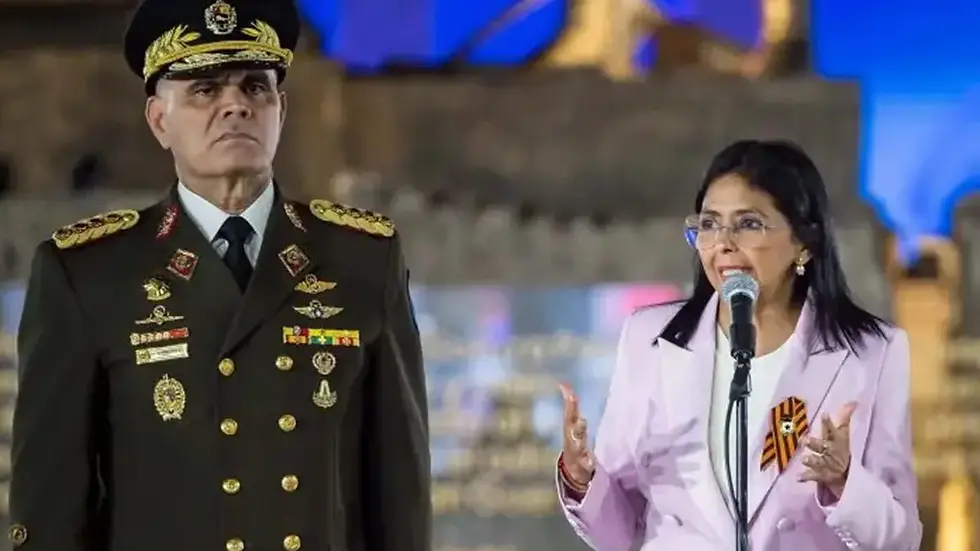
Alongside these reforms, the Rodríguez government has taken steps that insulate key figures and structures from the Maduro era. On 13 April, General-in-Chief Vladimir Padrino López was appointed Minister for Productive Agriculture and Lands, returning to the cabinet weeks after being removed as Defence Minister. Padrino López served as Maduro’s defence minister for nearly a decade and was identified by human rights organisations as a central figure in the violent repression of opposition protests in 2017 and 2019.
He is the subject of a $15 million US reward for information leading to his capture on drug trafficking charges. His reinstatement in a civilian ministry signals that the Rodríguez government is unwilling to break with the military figures who sustained the previous regime, even as it pursues economic liberalisation.
On 24 April, Rodríguez announced that the amnesty law approved in February to free political prisoners detained under Maduro would be wound down, just two months after its passage. During the Maduro years, the government detained thousands of political opponents, journalists, and activists. While 8,616 detainees have been released under the amnesty law, between 473 and 670 political prisoners remain in custody according to Foro Penal and other monitoring organisations.
Rodríguez indicated that remaining cases would be redirected to alternative mechanisms, including a criminal justice reform commission. Provea, a Venezuelan human rights organisation, rejected the move as arbitrary and unconstitutional, arguing that amnesty for political prisoners must be a foundational element of any reinstitutionalisation process rather than a time-limited gesture.
The Rodríguez government has also surpassed the 90-day constitutional limit on an acting presidency without a public legislative vote to extend the mandate, creating a legitimacy gap
that remains unresolved. The National Assembly, still dominated by the PSUV, has not moved to address this formally.
So what does the future hold?
The pattern is consistent: reforms that serve US strategic and commercial interests, particularly in the energy sector, are advanced rapidly, while accountability measures that would threaten the cohesion of the ruling party and the military are constrained or reversed.
This is not contradictory from a regime-survival perspective. The Rodríguez government needs international legitimacy and revenue to stabilise the economy, and it needs the loyalty of the security apparatus and party structure to remain in power. Oil reform and IMF re-engagement serve the first objective. The reinstatement of Padrino López and the winding down of the amnesty law serve the second.
For external actors, the implication is that Venezuela’s commercial environment is likely to continue improving in measurable ways, particularly for energy companies willing to operate within the framework Washington and Caracas are jointly constructing. Legal certainty, foreign exchange access, and contract enforceability are all moving in a more favourable direction. However, the political environment remains structurally opaque: the ruling party retains control.
of the legislature, the judiciary has not been reformed, and the treatment of political prisoners is now governed by ad hoc mechanisms rather than a statutory framework.
The opposition remains fragmented. María Corina Machado, the most prominent opposition figure, is in exile and met with President Trump in Washington earlier this year, but the Trump administration has signalled that it regards Rodríguez as the more cooperative partner and has not pressed for Machado’s return to a governing role. Domestic opposition actors operate under constrained conditions, with limited institutional space to exert pressure for deeper political
opening.
The trajectory is one of managed liberalisation under authoritarian continuity. The Rodríguez government is offering enough reform to secure external support while drawing clear boundaries around internal accountability. Whether this equilibrium holds will depend on Washington’s willingness to tolerate the protection track in exchange for energy access and geopolitical cooperation, and on whether the economic improvements currently under way prove sufficient to prevent the kind of popular pressure that neither reform nor repression can easily contain.