

Intel Brief: How the EU’s Enlargement Changes Its Security
Date: 21/07/2016
Context
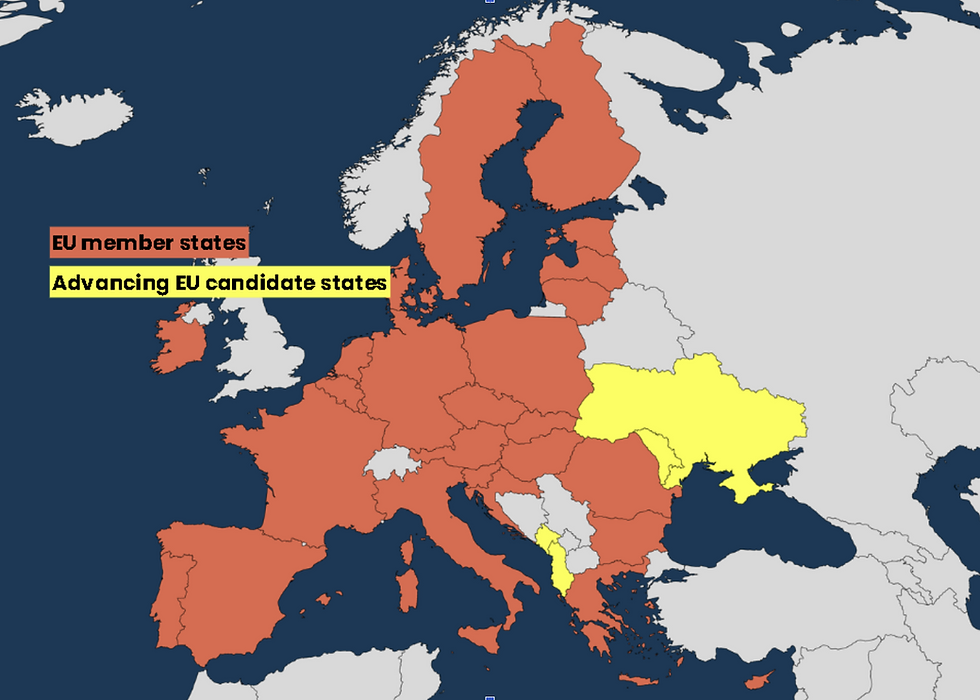
On 14/07, the EU held four accession conferences in a single day, the first time it has done so in more than two decades. Accession conferences are the formal meetings at which the EU and a candidate country open or close parts of the membership negotiation process. Holding four on the same day was a deliberate signal of momentum, and European Commissioner for Enlargement Marta Kos described the date as a "Super Tuesday" for EU enlargement. The last comparable moment came in 2002, ahead of the bloc's big eastward expansion.
The four countries advancing were Ukraine, Moldova, Montenegro, and Albania, though each at a different stage of the negotiation process. EU accession talks are organised into 33 thematic chapters, grouped into six clusters, each covering an area in which the candidate must align its laws and institutions with EU standards. Ukraine and Moldova opened Cluster 6 on external relations, which covers trade policy as well as foreign, security, and defence policy. Albania closed its first chapters, while Montenegro is now in the endgame of formal negotiations, having closed 18 of the 33 chapters.
The renewed drive reflects a shift in how Brussels views enlargement. Once treated primarily as an economic and institutional process, it is now increasingly framed as a security project: a way to build resilience against Russian coercion, deepen defence cooperation, and develop a more integrated European security architecture. Kos made this explicit, stating that the future security architecture of the continent is "unimaginable without Ukraine."
Russia, for its part, continues to view EU enlargement as a strategic threat and seeks to delay the accession process through hybrid activities. These include disinformation campaigns, cyber operations, political influence, and support for destabilising actors in candidate countries. China has expanded its economic leverage in the region, notably through investment and lending in the Western Balkans, but remains a secondary actor.
Despite the political momentum, progress remains merit-based. Candidate countries must complete extensive reforms and receive unanimous approval from all EU Member States before joining. That unanimity requirement means any single member state can slow or block a candidate's progress, and even for the frontrunners, membership is likely still years away.
Dyami’s Assessment
Ukraine
Ukraine has transformed into Europe's most combat-experienced military and now operates one of Europe's most battle-tested and operationally experienced integrated air and missile defence networks, combining Western systems (such as Patriot, SAMP/T, IRIS-T, NASAMS) with domestically developed capabilities. It views EU membership not only as an economic objective but as a long-term strategic anchor that complements its aspirations for NATO membership. Accession, in other words, is a two-way strategic bargain.
What Ukraine seeks:
A permanent European political and security anchor
Long-term defence and economic support
Access to the European defence industry
Protection from Russia's sphere of influence
What the EU gains:
A highly capable military partner with extensive battlefield experience
Advanced drone and defence-industrial capabilities
Operational lessons that can strengthen European defence planning
A more resilient eastern security frontier
At the same time, the EU assumes long-term security responsibilities that extend well beyond previous enlargement rounds. This mutual security relationship is likely to deepen through joint weapons production and defence technology cooperation, exemplified by the recent EU-Ukraine "Drone Deal", which combines Ukraine's battlefield-tested drone expertise with the EU's industrial capacity. Ukraine's operational experience is expected to play a significant role in shaping European capabilities in integrated air and missile defence, drones, and electronic warfare.
Russia, however, considers Ukraine's Euro-Atlantic integration a direct threat to its sphere of influence, making Ukraine the central geopolitical battleground between Russia and the West. As such, Russia is likely to intensify hybrid operations and long-range strikes aimed at undermining European support for Ukraine.
Moldova
Moldova remains one of Europe's most vulnerable security environments despite its constitutional neutrality. The country faces persistent Russian hybrid pressure through disinformation campaigns, cyber activities, and the unresolved Transnistria conflict, where Russian troops remain stationed. In response, Moldova has significantly strengthened cooperation with the EU, receiving financial support to modernise its air surveillance and air defence capabilities while accelerating accession reforms. On 13/07, the EU approved a €120 million support package under the European Peace Facility to fund a mid-range air defence system for Moldova.
What Moldova seeks:
Protection from Russian political interference
Relief from energy pressure and cyberattacks
A counterweight to the instability surrounding Transnistria
What the EU gains:
Strengthened preparedness on its eastern border
Reduced space for Russian influence
But also responsibility for a vulnerable state with limited military capacity
As accession progresses, Moldova is expected to become more resilient to Russian coercion through closer integration into European political, economic, and security structures. It will, however, continue to rely heavily on EU support rather than developing significant independent military capabilities.
Montenegro
Montenegro is the most advanced of the current accession candidates. As a NATO member since 2017, its defence policy is firmly aligned with Euro-Atlantic institutions, despite previous Russian attempts to influence domestic politics, including the alleged 2016 coup plot. Although Montenegro has limited military capabilities due to its size, it contributes to NATO operations and places emphasis on maritime security, interoperability, and regional cooperation. Its geopolitical orientation is decisively Western, with relatively limited Chinese or Russian strategic leverage compared with other Balkan states.
That said, Montenegro's experience with the Chinese-financed Bar–Boljare motorway convinced it of both the opportunities and risks associated with external investment. The nearly €1 billion loan from China's Export-Import Bank contributed to a sharp increase in public debt, prompting successive governments to rebalance towards EU and Western financial partners through currency hedging and fiscal reforms.
What Montenegro seeks:
Completion of its political and economic integration into the EU
Strengthened institutional stability
Investment and the long-term benefits of full membership
What the EU gains:
A politically and institutionally reliable partner that has consistently aligned itself with EU foreign and security policy
A demonstration that sustained reforms and alignment with EU values continue to lead to membership, providing an important benchmark for other Western Balkan candidates
Strengthened stability and maritime security cooperation in the Adriatic, even if Montenegro's direct military contribution remains modest
Reduced opportunities for external influence in the Western Balkans and the elimination of another geopolitical grey zone in Southeast Europe
As accession progresses, Montenegro is likely to close additional negotiating chapters while expanding cooperation on maritime security, regional interoperability, and NATO-EU coordination, reinforcing stability in the Adriatic and Western Balkans.
Albania
Albania has emerged as one of the EU's fastest-moving Western Balkan candidates while maintaining strong alignment with both NATO and EU foreign policy. It hosts NATO facilities, supports regional security initiatives, and has consistently backed sanctions against Russia following the invasion of Ukraine. Defence modernisation focuses on improving interoperability, cyber security, and support for NATO operations rather than developing extensive national capabilities.
Geopolitically, Albania is among the most pro-Western countries in the Balkans, with limited Russian influence and comparatively modest Chinese economic involvement.
What Albania seeks:
Full political and economic integration into the EU
Stronger democratic institutions
Investment and reinforced long-term economic development
Consolidation of its position within the Euro-Atlantic community
What the EU gains:
A reliable and firmly pro-Western partner that reinforces stability across the Western Balkans
A demonstration that institutional reforms, rather than geopolitical alignment alone, remain the decisive criterion for membership, reinforcing the credibility of the enlargement process
Consolidation of a coherent European political and security space, reducing opportunities for external influence
The principal challenge to accession for Albania is not strategic alignment but institutional readiness. The pace of negotiations will depend on the sustained implementation of judicial, anti-corruption, organised crime, and rule-of-law reforms, supported by durable institutional results. As accession progresses, Albania is likely to deepen cooperation with the EU on cyber defence, regional security initiatives, and NATO interoperability, while continued progress on those reforms will remain the principal determinant of its accession timeline.
Dyami’s Analysis
The simultaneous progress of Ukraine, Moldova, Montenegro and Albania demonstrates that EU enlargement has evolved from a primarily economic and political process into a strategic security instrument. Rather than offering membership solely as a reward for reform, the EU is increasingly using accession to reduce vulnerable geopolitical grey zones, strengthen resilience against Russian coercion and create a more coherent European security architecture.
However, the geopolitical bargain differs for each candidate. Ukraine brings substantial military capability but also significant long-term security commitments for the EU. Moldova primarily strengthens the Union by reducing Russian influence on its eastern border, despite limited defence capacity. Montenegro and Albania contribute less through military capabilities than through consolidating Western integration in the Balkans and reducing opportunities for external actors to exploit political and institutional gaps.
As a result, future enlargement will increasingly be judged not only by candidates' progress on reforms, but also by its contribution to Europe's long-term security, resilience and strategic autonomy.
Accelerating enlargement carries important risks. Political pressure to deliver rapid progress could outpace the implementation of judicial, anti-corruption and rule-of-law reforms, undermining the credibility of the accession process. Negotiations meanwhile remain vulnerable to bilateral disputes and unanimity requirements. Russia is likely to intensify hybrid activities aimed at delaying accession progress and weaken popular support.
Unresolved territorial issues could also complicate integration. If these issues result in prolonged accession timelines, they risk generating public frustration in candidate countries, potentially weakening reform momentum and increasing opportunities for external actors to exploit domestic discontent.


